The Root Zone: Surface Area Is Everything
When a floating wetland mat goes into the water, the plants growing on its surface send roots down through the mat and into the water column. Those roots don't just dangle there. They branch, subdivide, and expand into dense underwater canopies that create an enormous amount of submerged surface area relative to the size of the island itself.
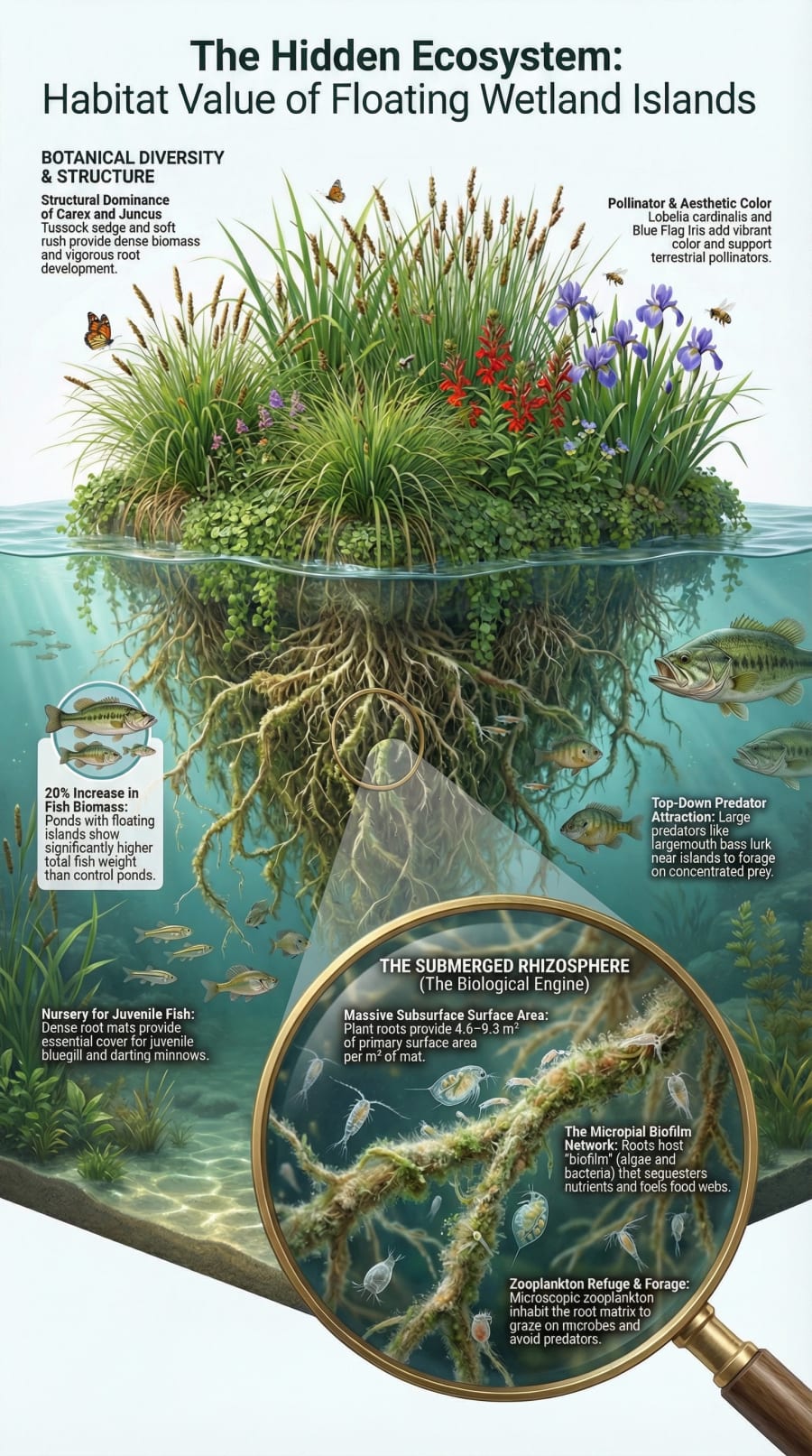
How much surface area? Research has measured the primary root systems of floating wetland macrophytes at 4.6 to 9.3 square meters of root surface for every square meter of mat (Tanner & Headley, 2011; cited in Neal & Lloyd, 2018). That means a modest 12-square-meter floating island can generate over 100 square meters of biological attachment surface below the waterline.
This matters because that surface area gets colonized. Within weeks, bacteria, algae, cyanobacteria, heterotrophs, and other microbes develop into three-dimensional periphyton and biofilm communities on the roots and the mat's polymer matrix (Neal & Lloyd, 2018). This periphyton community creates what researchers call a "concentrated wetland effect," trapping fine suspended particles and transitioning nutrients through the food web (Stewart et al., 2008; cited in Neal & Lloyd, 2018).
Every square meter of floating wetland mat generates 4.6 to 9.3 square meters of submerged root surface for biological colonization. A floating wetland isn't just a plant. It's an infrastructure project for microbes.
Clemson University's extension research confirms that approximately 80% of floating wetland treatment efficacy comes from this microbial biofilm activity on root surfaces, with only about 20% attributable to direct plant nutrient uptake (Escamilla, Scaroni & White, 2024). The roots aren't the treatment system. They're the scaffolding for the treatment system. The biofilm is the engine.
The Biofilm Gradient: A Treatment Plant on Every Root
The biofilm colonizing floating wetland roots isn't uniform. A 2015 study at Florida Gulf Coast University made a discovery that helps explain why floating wetlands are so effective at nitrogen removal: the microbial community growing on root surfaces self-organizes into distinct biochemical zones (Dettmar, 2015).
Despite the presence of dissolved oxygen in the surrounding water, the microbial community found on floating wetland root biofilms was "typical of oxic as well as anoxic and even anaerobic environments" (Dettmar, 2015). The researcher hypothesized that the biofilm creates a redox gradient from its surface to its basal layer: aerobic conditions on the outer face, transitioning through anoxic zones in the middle, to anaerobic conditions at the root surface.
Why does this matter? Because each zone supports different microbial functional groups, and together they run the complete nitrogen cycle on a single root. The outer aerobic layer supports nitrifying bacteria that convert ammonia to nitrite and then nitrate. The anoxic middle zone supports denitrifying bacteria that convert nitrate to nitrogen gas, permanently removing it from the water. The inner anaerobic layer supports sulfate-reducing bacteria, which further contribute to nutrient cycling.
Floating wetland root biofilms self-organize into layered microbial communities that simultaneously perform nitrification, denitrification, and sulfate reduction on a single root system. Each root functions as a self-contained, multi-stage water treatment facility.
This self-organizing gradient is a key reason why floating wetlands achieve nitrogen removal rates of 70-97% in research settings (Escamilla, Scaroni & White, 2024). Traditional constructed wetlands need separate aerobic and anaerobic zones designed into them. Floating wetland roots build those zones automatically, at microscale, on every root in the system.
The Food Chain Builds Itself
Biofilm on root surfaces isn't just processing nutrients. It's also food. The periphyton community coating floating wetland roots is a nutrient-rich food source for grazing invertebrates, and those invertebrates are food for fish. What starts as microbial colonization on submerged roots becomes, over time, a complete aquatic food web.
Research dating back to the 1970s has shown this relationship is direct and linear. In mesocosm experiments, doubling the available periphyton attachment surface produced an increase of 384 kg/ha of bluegill biomass in 180 days, driven by increased macroinvertebrates on the substrates, particularly those in the orders Diptera, Hemiptera, Odonata, and Plecoptera (Pardue, 1973; cited in Neal & Lloyd, 2018). More surface area means more biofilm. More biofilm means more invertebrates. More invertebrates means more fish.
A 2025 EU research summary on artificial floating islands in Portugal confirmed that these structures function as "biodiversity hotspots," providing shelter, food, and breeding sites for insects. Of particular note, researchers documented complete lifecycles of at least 10 different species of dragonflies and damselflies (Order Odonata) associated with the floating platforms (EU DG Environment, 2025; summarizing Calheiros et al., 2025). These predatory insects are biological indicator species for aquatic ecosystem health, and their presence signals a functioning food web.
Floating wetland root systems support complete invertebrate lifecycles and create a trophic cascade from biofilm to invertebrates to fish. The food chain isn't introduced. It assembles itself on the root infrastructure.
The Yale E360 profile on floating wetlands in Chicago, Baltimore, and Boston documented similar patterns, noting that root systems create "riverponic" habitats where invertebrates, mollusks, crustaceans, and fish colonize even in heavily urbanized waterways (Cosier, 2022). The National Aquarium's Baltimore installation found that microscopic organisms on roots help move nitrogen through the food chain, from barnacle to crab to fish (Cosier, 2022).
UV Radiation, Shade, and the Zooplankton Paradox
Zooplankton are the unsung workhorses of pond and lake ecosystems. They occupy the critical middle position in the food web, channeling energy from algae and microorganisms to invertebrate predators and fish (Rautio & Tartarotti, 2010). They're also the primary grazers that keep algae populations in check. When zooplankton populations are healthy, algae blooms are naturally controlled from the top down.
The problem is that solar ultraviolet radiation has many deleterious effects on zooplankton. UV-B radiation (280-320 nm) causes direct DNA damage, and UV-A radiation (320-400 nm) compounds the problem. A comprehensive review of the research found that both laboratory and field studies consistently show that zooplankton are negatively affected by high UV intensities, with effects ranging from reduced reproduction to direct mortality (Rautio & Tartarotti, 2010).
Zooplankton have evolved several protection strategies, but they face a brutal tradeoff. Some species produce UV-absorbing pigments like red carotenoids or black melanin. These are effective sun shields, but they make the zooplankton highly visible to fish predators (Hansson, 2000; Hylander et al., 2009; cited in Rautio & Tartarotti, 2010). In waters with fish present (which is to say, virtually every managed pond and lake), pigmentation as a UV defense is a losing strategy. The zooplankton survive the sunlight but get eaten.
The alternative is behavioral: vertical migration deeper into the water column during daylight hours, or seeking physical shade. This is where floating wetlands change the equation. The mat surface shades the water directly below the island, and the dense root canopy creates a structured, low-light zone extending into the water column. This gives zooplankton a UV-protected refugium where they can shelter during the day without the visibility cost of pigmentation.
At night, when UV is absent, these zooplankton emerge to graze algae across the broader water body. The result is intensified nocturnal grazing pressure on algae populations, driven by a zooplankton community that is sheltered, healthy, and reproducing at higher rates because of reduced UV stress.
Floating wetlands create UV-protected refugia where zooplankton populations can thrive without the predation tradeoff of UV-protective pigmentation. This supports larger zooplankton populations and enhanced natural algae control through increased grazing pressure.
The zooplankton refugia mechanism is well-supported by UV biology research and temperate-zone studies on floating macrophyte cover (Fontanarrosa et al., 2010). However, a Florida study found that zooplankton did not preferentially use FTW roots as daytime refugia in subtropical ponds, noting this is "typical of subtropical systems" (Dettmar, 2015). The refugia effect appears strongest in temperate systems, which covers the majority of the North American market. More research is needed to fully characterize this mechanism across climate zones.
Allelopathy: Plants That Fight Algae Directly
Beyond biofilm, beyond shade, there may be a third biological control mechanism at work under floating wetlands. Dettmar's 2015 study investigated whether chemical compounds released by floating wetland plant roots could directly inhibit algae growth through a process called allelopathy.
Using both liquid culture assays and agar diffusion assays, the researcher tested methanolic extracts from the roots of two common floating wetland species, soft rush (Juncus effusus) and canna lily (Canna flaccida), against multiple algae species. The results were striking: root extracts from both species inhibited growth of Cyanophyceae (blue-green algae), the group responsible for harmful algal blooms and cyanotoxin production (Dettmar, 2015).
Interestingly, the same extracts sometimes enhanced the growth of Chlorophyceae (green algae), which could be beneficial since green algae are generally a preferred food source for zooplankton and do not produce the harmful toxins associated with cyanobacteria.
Root extracts from common floating wetland plants have been shown to inhibit cyanobacteria growth through allelopathic compounds, suggesting a direct biochemical mechanism for harmful algal bloom control beyond nutrient removal.
Allelopathic algae control by floating wetland roots is a promising but still-developing area of research. Dettmar's thesis is one of the first studies to investigate this mechanism specifically in FTW systems. The agar diffusion assay showed stronger inhibition than the liquid culture assay, where allelopathic compounds were diluted. The author noted that more investigation should be conducted across different systems and species to determine whether these findings are universal or site-specific.
Why Chemical Treatment Makes the Problem Worse
Most pond and lake managers facing algae problems reach for copper-based algaecides. They're cheap, easy to apply, and they kill algae on contact. But the collateral damage creates a cycle that makes the underlying problem worse.
Copper-based algaecides don't just kill algae. Studies have shown that cladocerans, including Daphnia magna, Daphnia pulex, and Daphnia similis, are highly susceptible to copper toxicity at the concentrations used for algae treatment (Cyrino de Oliveira-Filho et al., 2004; cited in Dettmar, 2015). Daphnia are among the most important algae-grazing zooplankton in freshwater systems. When you kill them, you remove the biological brake on algae growth.
Developing juvenile fish are also susceptible to copper toxicity (Hanson & Stefan, 1984; Karan et al., 1998; cited in Dettmar, 2015). The very organisms you're trying to protect, and the organisms that would naturally control the algae for you, are being harmed by the treatment.
To make matters worse, there's evidence that cyanobacteria (the harmful blue-green algae that produce toxins) are developing increased tolerance to copper (Garcia-Villada et al., 2004; cited in Dettmar, 2015). The algae you most want to control are becoming the ones most likely to survive the treatment, while the organisms that naturally control them are killed.
Copper-based algaecides kill zooplankton grazers that naturally control algae and harm developing juvenile fish, while cyanobacteria develop increasing copper tolerance. This creates a treatment dependency cycle. Floating wetlands build the biological populations that control algae naturally, reversing the cycle instead of reinforcing it.
Dettmar summarized it directly: "The use of algaecides does not cure the problem of eutrophication; rather, it merely treats a symptom" (Dettmar, 2015). Floating wetlands address the root cause by reducing nutrient availability (both external and internal loading), building grazer populations, providing fish habitat, and potentially even suppressing harmful species biochemically.
The Compound Effect: Why Floating Wetlands Get Better Over Time
Chemical treatments degrade over time. Organisms develop resistance. Chemicals accumulate in sediments. Each application is a standalone event that doesn't build on the last one. Floating wetlands work the opposite way. Every season adds capacity.
Root networks expand, increasing the total biofilm-colonizable surface area. Microbial communities diversify and mature, improving nutrient processing efficiency. Invertebrate populations establish and reproduce. Fish respond to the improved food supply and habitat. The system compounds.
In a replicated experimental pond study, floating wetlands covering just 2.3% of pond surface area produced 19.9% greater total fish biomass compared to control ponds, with 29.8% greater juvenile bluegill biomass (Neal & Lloyd, 2018). The researchers noted that dense root growth beneath the floating structures was "present but still developing at the end of the study," suggesting that the system had not yet reached its full productive potential.
From a cost perspective, a 2025 international analysis by CSIRO and the University of South Australia found that floating wetland nitrogen removal costs ranged from A$15 to A$183 per kilogram, and that larger installations and warmer climates reduced costs further through economies of scale and longer growing seasons (Awad et al., 2025). Clemson University data shows a breakeven period of 4-13 years compared to chemical treatment programs, after which treatment is essentially ongoing at minimal maintenance cost (Escamilla, Scaroni & White, 2024).
Floating wetlands covering just 2.3% of pond surface area produced 19.9% greater total fish biomass in replicated trials, and the root systems were still developing at study's end. Unlike chemical treatment, floating wetlands are a compounding investment in water quality and biological productivity.
Natural Waterscapes is currently conducting hands-on floating wetland installations as part of an ongoing trophy fishery recovery collaboration in Alabama. We're documenting the water quality improvements and fish population response in real time. That data and video content is coming soon. In the meantime, everything on this page is drawn from peer-reviewed research and university extension publications you can read yourself.
Ready to size a system? See pre-built island configurations and pricing.